
Creating Democracy: The Declaration of Independence and the Rhetorical Ethics of the Colored Convention Movement
Keynote Address for the Philosophy and Communication Conference at Duquesne University

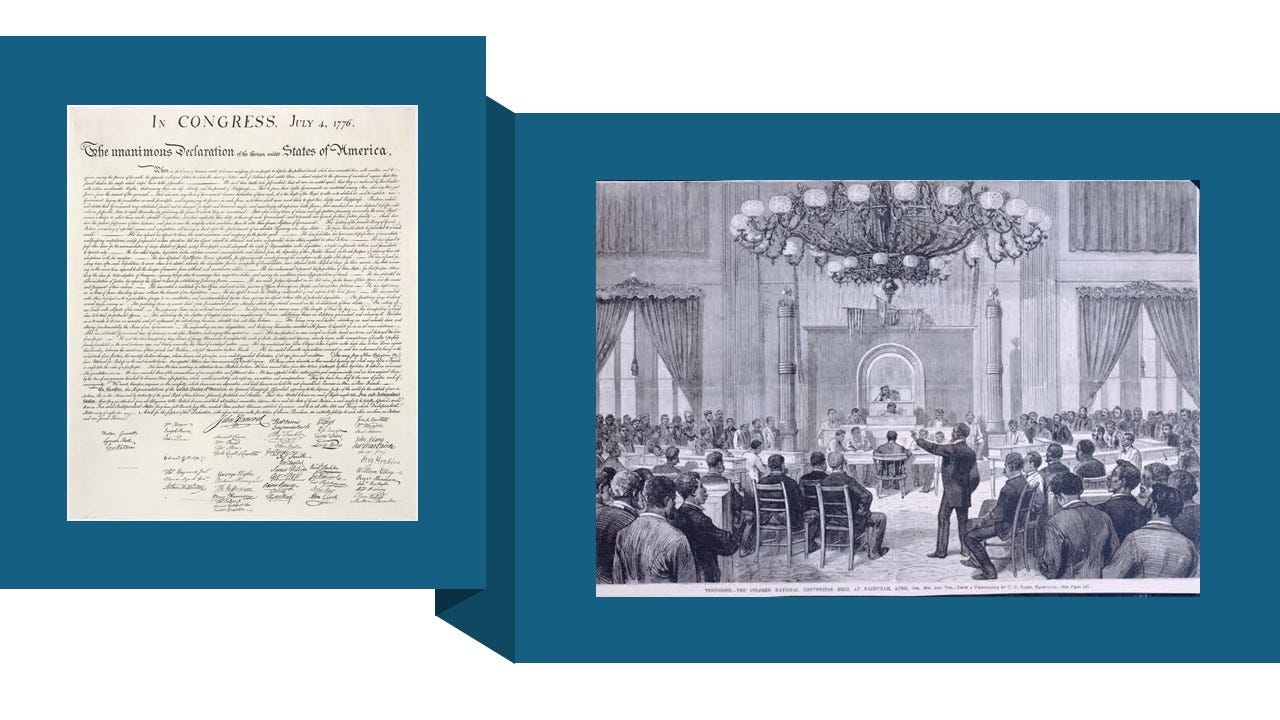
On May 27, 2026, I delivered an address at the Philosophy and Communication Conference at Duquesne University, focusing on how delegates and attendees at the Colored Conventions engaged the Declaration of Independence. Rather than distancing themselves from the document because of the contradictions inherent in its authors, these individuals embraced its ideals of freedom and equality with deep respect and earnestness. This dedication enabled them to develop some of the most compelling rhetoric centered on patriotism, democracy, and liberty in American history. Their impactful speeches and writings not only celebrated the principles espoused in the Declaration but also emphasized the ongoing struggle for civil rights and justice. This rich tradition of rhetoric showcases how African Americans interpreted and revitalized foundational American texts to advocate for their rights and dignity, creating a legacy that continues to resonate in contemporary discussions of liberty and justice.
In celebration of the upcoming 250th anniversary of the United States of America, I taught a class on the Declaration of Independence. Taught at Memphis Theological Seminary and titled A Religious Understanding of the Declaration of Independence, the course investigated the religious dimensions of the Declaration and the rhetorical power of its appeals to divine authority, natural law, and moral order. In the class, students analyzed how the text drew on Enlightenment thought, biblical language, and theological concepts to construct its vision of rights, justice, and legitimacy. Through rhetorical and historical analysis, we explored how religious ideas shaped early American political discourse and how later movements—abolition, civil rights, and modern political theology—have reinterpreted the Declaration’s sacred and civic claims. It was my hope that by the end of the course, students would understand how religion and rhetoric intersect in shaping American identity and democratic ideals.
As our texts, we used Danielle Allen’s Our Declaration: A Reading of the Declaration of Independence in Defense of Equality and Mary Stuckey’s edited collection Used, Abuse, and Sidelined: Debating the Declaration. I also included other essays and speeches, but the bulk of the class was focused on a close reading of the Declaration. Students in our class were really engaged with the reading of the Declaration, many of them reading it as a whole for the first time. Together, we unpacked meanings, analyzed the contexts that gave rise to the Declaration, asked questions, debated, and interrogated what understanding the Declaration would mean in many of the situations we face today.
During our class discussions, we explored the complexities of the founders’ actions and beliefs, particularly the hypocrisy that manifested at the time. In short, many students found it challenging to reconcile the ideals expressed in the founding documents, particularly those championing liberty and the rights of individuals, with the troubling reality that the very architects of these liberating principles were not only complicit in the institution of slavery but also engaged in the ongoing trafficking of human beings. This cognitive dissonance was profound, as we explored how these same individuals, who articulated the anguish of oppression and the aspirations for freedom, simultaneously denied those same privileges to others for their own benefit. In the class, we sought to understand the contradictions in their legacies and the moral implications of their choices, prompting rich discussions about justice, ethics, and the ongoing impact of these historical narratives on our contemporary society.
However, in stark contrast to the Framers’ fraught understanding of the document’s power, delegates and attendees at the Colored Conventions approached the Declaration of Independence with profound respect and earnestness. Rather than separating themselves from its principles due to the inconsistencies of its authors, they passionately embraced its ideals of freedom and equality. This engagement allowed them to craft some of the most compelling patriotic, democratic, and liberty-focused rhetoric in American history. Their powerful speeches and writings not only celebrated the Declaration’s commitments but also highlighted the ongoing struggle for civil rights and justice. This rich tradition of rhetoric, linked to the Colored Convention movement, illustrates how African Americans reinterpreted and revitalized foundational American texts to advocate for their own rights and dignity, thereby creating a legacy and a model that resonates through modern discussions of liberty and justice.
Take, for instance, the very first convention held at Bethel AME Church in Philadelphia in 1830. The Convention movement was born out of the atrocity that happened a year earlier in Cincinnati, Ohio. For three horrific days, white mobs terrorized Black communities, forcing many of them to leave the city. As P. Gabrielle Foreman notes, “In need of a ‘place of refuge’ and ‘obliged to leave their homes,’ more than 1,000 of Cincinnati’s Black residents became forced migrants in Canada after being dragged through the streets of the city then known as ‘the Queen of the West.” As the outrage continued, Black leaders gathered in Philadelphia to “protest and plan.”1
Meeting openly from September 20-24, 1830,2 some forty delegates representing seven states met with a “firm and settled conviction,” grounded in their understanding of “inestimable and invaluable instrument, namely, the Declaration of Independence,” that their “forlorn and deplorable situation earnestly and loudly demands of us to devise and pursue all legal means for the speedy elevation of ourselves and brethren to the scale and standing of men.”
The declaration was read aloud at some conventions. One declared that the declaration was “one of the greatest documents the world has ever seen.” In the address to the state colored convention in Ohio in 1844, delegates stated that “The Declaration of Independence, the American Bill of Rights, the Ordinance of 1787, as well as the Political Creed of every intelligent, generous and patriotic freeman, are clearly violated, nay shamefully desecrated by that feature of our constitution that renders the color of the skin a qualification for electors and suffrages.
At the Massachusetts State Colored Convention on August 1, 1858, William Wells Brown expressed his heartfelt congratulations to the assembly for coming together on such an important occasion. The date marked the anniversary of the emancipation of enslaved individuals in the West Indies, a pivotal moment that resonated deeply within the African American community and beyond.
Brown emphasized not only the importance of celebrating the West Indies' achievements in securing their freedom but also the pressing need to assert their own rights as individuals. He passionately articulated their natural rights, rights that are inherent and recognized in the Declaration of Independence. “We meet,” he declared with conviction, “to proclaim to the world that we have rights that are not granted by the American Government, but by our Creator. These rights are intrinsic to our humanity and cannot be stripped away by any Congress or Legislature.”
The delegates of the Colored Convention in the State of Virginia in 1865 wrote that:
We claim, then, as citizens of this State, the laws of the Commonwealth shall give to all men equal protection; that each and every man may appeal to the law for his equal rights without regard to the color of his skin; and we believe this can only be done by extending to us the elective franchise, which we believe to be our inalienable right as freemen, and which the Declaration of Independence guarantees to all free citizens of this Government and which is the privilege of the nation. We claim the right of suffrage:
At the same convention, they agreed to a resolution that read in part:
Resolved, That we claim to be a part of the United States, as represented in the preamble to the Constitution of the United States. Also as a part of the people which the Declaration of Independence declares to be free and equal, and we believe that the framers of the Constitution and originators and signers of the Declaration of Independence never contemplated otherwise than a perfect equality before the law to all the inhabitants of the Government.
In their Declaration of Sentiment at the 1835 National Colored Convention, the committee wrote:
Let no man remove from his native country, for our principles are drawn from the book of divine revelation, and are incorporated in the Declaration of Independence, “that all men are born equal, and endowed by their Creator with certain inalienable rights; that among these are life, liberty, and the pursuit of happiness.” Therefore, our only trust is in the agency of divine truth, and the spirit of American liberty; our cause is glorious and must finally triumph.
The 1840 New York State Colored Convention mentions the Declaration throughout. The address to the delegation and to all people offers an example of how many Black people thought about the Declaration. They wrote:
We have no reason to think that the framers of the Declaration of Independence, in setting forth the doctrines it contains, regarded them as mere dogmas or idle theories. We believe they put full faith in them, as actual truths, and living verities. This they evinced, by pledging to each other their lives, their fortunes, and their sacred honors. This they manifested, by an unswerving opposition to injustice and oppression.
They closed by letting the world know that they did not ask for any “vested rights, for no peculiar privileges, for no extraordinary prerogatives.”
We merely put forth our appeal for a republican birthright. We wish to be something more than political serfs and slaves. We fully believe in the fundamental doctrines set forth in the Declaration of Independence. We acquiesce in the sentiment that “governments derive their just powers from the consent of the governed.” And we say it is injustice of the most aggrieved character, either to deprive us of a just and legitimate participation in the rights of the State, or to make us bear the burdens, and submit to its enactments…We ask for a living manifestation of belief in the above doctrine: we know already too much of its dead letter.
In the New England Colored Convention in 1859, William Wells Brown declared to the convention that, “Our right to live here is as good as the white man’s, and is incorporated in the Declaration of Independence, in the passage which declares ‘that all men are created equal, and endowed by their Creator with certain inalienable rights; that among these are life, liberty, and the pursuit of happiness.’”
“Then let us remain here,” he continued, “and claim our rights upon the soil where our fathers fought side by side with the white man for freedom. Let us remain here and labor to remove the chains from the limbs of our brethren on the banks of the Mississippi. Yes, let us stay here, and vindicate our right to citizenship, and pledge ourselves to aid in completing the Revolution for human freedom, commenced by the patriots of 1776, and see our country as free as the air we breathe.
At the New York State Convention in 1866, delegates offered resolutions that drew on the Declaration’s appeal.
Resolved, That the claim we make is for impartial suffrage, and that the duty of the Republican and Democratic parties of the State is to assist us by every means in their power—the first (or Republican) party because it professes to base all its action upon the Declaration of Independence, which says, “all men are created (politically) equal; and the other (the Democratic party) because it professes to believe fully in the Jeffersonian doctrine of equal and exact justice to all men.”
In speaking on voting rights and calling on the state of California to grant suffrage to Black men, one keynote speaker proclaimed:
We appeal to them upon the principle of man’s natural equal rights, as vindicated and set forth in the “Declaration of American Independence”--upon which rests the foundation of the Republic. That declaration sets forth that “All men are created equal” in human rights, or have the same natural rights, which man cannot justly invade or take away; and that to secure these rights equally to all men, “Governments are established among men, deriving their just powers from the consent of the governed.” This is the doctrine of the Declaration of Independence; if this sentiment is wrong, why do not the American people blot it from their political creed? If it is right, then we appeal for our natural right to “Equality before the Law,” as it sets forth. We appeal to them as friends of their own Republican principles, which they violate when they refuse us the right of suffrage.
When the delegates at the Ohio State Colored Convention in 1857 called upon the state government to amend its constitution by striking the word “white” out of the state constitution, they wrote:
The Declaration of Independence, and the American definition of human freedom, declares that all men are created equal--that is, that all are equally endowed with natural and inherent rights. These rights are not created by Constitutions, nor are they uncreated by Constitutions…When government fails to perform this function, its acts become unjust, anti-democratic, and cruel. And then it becomes the duty of the law-making power of the State to alter and amend the laws in such a manner as to secure equal and exact justice to every inhabitant. In the name of the manhood of black and mulatto persons, then,--in the name of his inherent rights, which are inseparable from that manhood--and in the name of the true function of government, we ask the amendment of the Constitution.
In examining how delegates spoke about the Declaration of Independence, one also notes that during these conventions, participants not only shared their personal narratives and experiences but also collectively affirmed their humanity in a society that constantly and consistently sought to marginalize them. This platform allowed them to challenge systemic injustices and confront racial discrimination directly. Furthermore, these gatherings fostered a profound sense of community among attendees, promoting solidarity and collaboration in the fight for civil rights. In essence, the Colored Conventions represented a critical juncture for Black activism, where individuals came together to advocate for their rights, celebrate their identities, and strategize for a future in which they could fully claim their place as equal members of society, despite the pervasive obstacles in their way.
Moreover, their understanding of the Declaration of Independence was deeply rooted in their faith and spirituality. This spiritual foundation provided not only a source of strength and resilience but also a framework for critiquing the theological narratives that justified racism and social hierarchies. Participants often grappled with the prevailing ideology that portrayed God as an ally of the oppressor and sought to reframe these beliefs by emphasizing a divine commitment to justice, liberation, and the inherent dignity of all people.
The conventions promoted a prophetic rhetoric that courageously spoke truth to power, illuminating the harsh realities of injustice faced by the Black community. This rhetoric was not merely a call to awareness but a clarion call to action, advocating collective liberation achievable only through engaged communal deliberation and a commitment to moral clarity. By fostering dialogue among delegates, these conventions became incubators for ideas and strategies to dismantle systemic oppression and empower individuals to pursue justice and equality.
Grounded in the tenets of the Declaration, the Colored Conventions emerged as a movement in the struggle for civil rights and social justice, serving as a powerful platform for Black individuals to unify and express their aspirations for equality and justice. These conventions brought together delegates from various regions to share their ideas and experiences, fostering a rich environment for dialogue and activism.
Within this setting, delegates were not only exposed to some of the era’s most compelling oratory but also invigorated by the eloquence and passion of their peers. The speeches delivered at these conventions inspired attendees to return to their communities with renewed determination, equipped to continue the ongoing fight for justice and equality.
The messages conveyed during these gatherings, including strong calls for freedom, liberty, and democracy, laid the groundwork for critiques of racism and oppression that resonate in contemporary discussions. Many of the fundamental ideas and arguments articulated by convention delegates became the bedrock for future movements and struggles, fundamentally shaping the landscape of civil rights in America. The Colored Conventions thus played an instrumental role not only in defining the aspirations of Black Americans in their quest for justice but also in pioneering the tactics that would fuel future generations of activism.
In his foundational book, Negro Orators and Their Orations, Carter G. Woodson challenges prevailing notions of oratory and critiques the concept of the “real orator.” According to his perspective, the “real orator” does not confine themselves to the rigid structures and conventions of rhetorical theory. Instead, they prioritize engaging their audience in a meaningful dialogue—one that confronts and stimulates thought around the ongoing struggle between the “real” and the “ideal.” The oration itself emerges from this dynamic tension, where the orator skillfully embodies both the harsh truths of current circumstances and the lofty goals of social justice and equality.3
The aim is for both the orator and the audience to critically unpack these concepts, fostering a more profound understanding that can inspire collective action. By doing so, they aspire to align societal realities more closely with their aspirational ideals, creating a harmonious future grounded in the hope of what could be.
Woodson builds on what we see expressed in the hundreds of addresses delivered at the conventions. He emphasizes that compelling oratory is not solely the domain of individuals holding high governmental positions or prominent societal roles. Instead, he believes that the most compelling speeches come from those deeply motivated to bring about change in the prevailing social order. For Woodson, true oratory is born from authentic experiences of suffering—whether one has personally endured hardship or has witnessed the pain suffered by others. This connection to human struggle fuels a passion to articulate those injustices.
Woodson’s concept of oratory “springing up from the breasts of patriots” suggests an inner drive or compulsion to speak out, stemming from a profound sense of duty. Conventional rules and regulations do not bind this type of oratory; instead, it emerges from a place of deep conviction and moral obligation. It becomes a vehicle for expressing a yearning to rectify societal wrongs and to strive for balance and harmony among all individuals.
In Woodson’s view, good oratory serves a critical and ethical function: it challenges the status quo, which often perpetuates oppression and undermines the fundamental rights to life, liberty, and justice. By rejecting the established order, such speeches advocate for a more equitable and humane society, reflecting the aspirations of those who are committed to making a meaningful difference. Good oratory, therefore, embodies a powerful call to action that resonates deeply with the collective human experience and the pursuit of justice.
In what Woodson describes, what oratory is and is not, how it functions, where it comes from, and how an orator performs it, one can find all that and much more in reading the speeches and writings from the minutes and newspaper reporting of the Colored Conventions. The orators involved in these conventions were often not formally trained in the conventional methods of rhetoric or the structured art of oratory. However, a closer examination of their rhetorical strategies reveals remarkable sophistication. They skillfully navigated the delicate balance between “the real and the ideal,” articulating profound truths while confronting harsh realities.
Their speeches drew deeply from democratic principles, highlighting a stark contrast to the practices of their opponents, who frequently failed to live up to the lofty ideals they publicly espoused. The orators urged society to embody the principles of equality and justice, which were often professed but seldom implemented. Within the pages of the Colored Conventions, one can discern a resounding yearning from “the breast of these patriots.” This fervent desire served as a clarion call for transformative change—challenging and seeking to overturn the entrenched “established order of things.” The conventions became a vibrant platform for advocates of social justice and equality, reflecting their aspirations for a more just and equitable society.
In conclusion, the Colored Conventions continue to bear witness today. Every time elected leaders devise ways to suppress votes, the conventions bear witness. Every time people are denied due process or unfairly restricted in their pursuit of life, liberty, and happiness, the conventions bear witness. Every time the weight of oppression finds its home with those on the margins of society, the conventions bear witness. When the wicked don’t cease from troubling, and the weary don’t find rest, the conventions bear witness.
They bear witness to a movement led and operated by Black folks who dared to believe they mattered. They bear witness to a movement that established a Black rhetorical tradition that reexamined and created the meaning of democracy, freedom, citizenship, and justice. They bear witness to a movement that became the intellectual hub for activists and a point of ongoing state and national collaboration. They bear witness to a movement grounded in a faith that did not fully accept the tenets of what would become a theology rooted in the notion of a racist God.
They bear witness to a movement that spoke truth to the proverbial powers yet had time to speak some truth to each other as well. They bear witness to a movement that discerned the signs of their times and spoke directly to them without any shame. They bear witness to a movement where people argued and debated, were performative and sometimes petty, but also profound and persistent. They bear witness to a movement that reminds all of us, as Charles Langston said in 1866, “We must be a constant trouble in the State until it extends to us equal and exact justice.”
It is this movement and its spirit that we must claim today.
Thank you
P. Gabrielle Foreman, Black Organizing, Print Advocacy, and Collective Authorship: The Long History of the Colored Conventions Movement in, P. Gabrielle Foreman, Jim Casey, and Sarah Lynn Patterson (eds), The Colored Conventions Movement: Black Organizing in the Nineteenth Century. North Carolina Press, 2021, 21
Delegates first met in secret from August 15 to 20, 1830. Afterward, they voted to hold open sessions, “come what may.” See Bella Gross, The First National Negro Convention, The Journal of Negro History, Oct., 1946, Vol. 31, No. 4 (Oct., 1946), pp. 435 443, 435
Andre E. Johnson, “My Sanctified Imagination: Carter G. Woodson and a Speculative (Rhetorical) History of African American Address.” Rhetoric and Public Affairs, 24, 1-2 2021, 15-49, 24